A spare-part master with the spare BoM for every asset — which belts, bearings and seals each machine consumes. Issue spares against a repair, hold reorder levels so nothing runs out, and read spare stock, ledger and MIS at a glance. So a breakdown waits on the fix, never on the part. Cloud or on-premise, for manufacturers of every kind.
Spares here aren't a separate store nobody trusts — every spare is tied to the assets it fits in the asset register, and every movement is a document on the spare ledger.
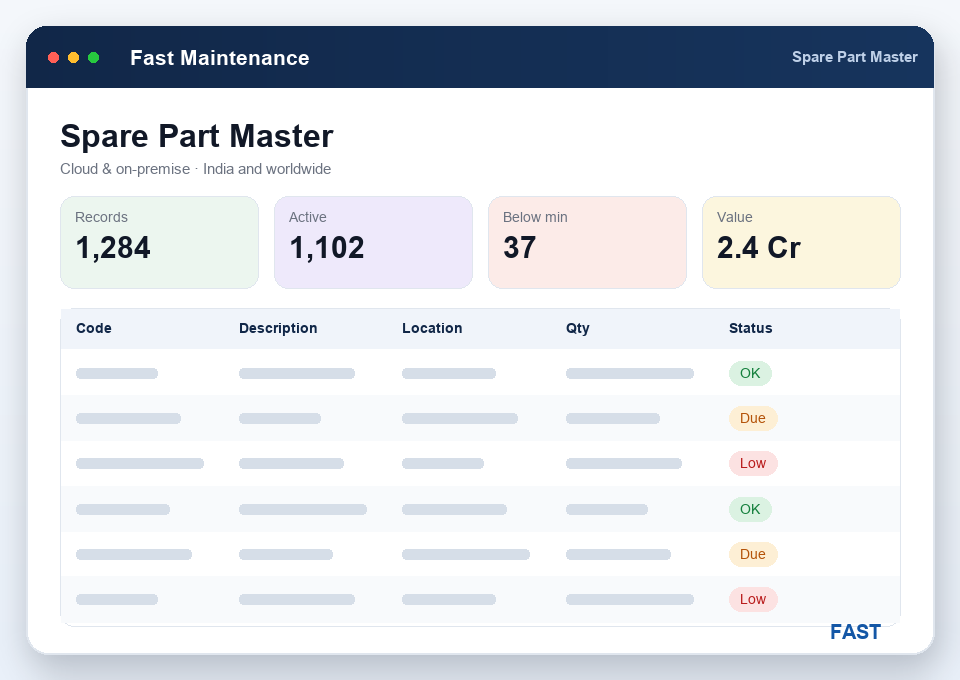
The spare-part master is where every belt, bearing, seal, filter and consumable is defined once — item code, description, unit of measure, quantity on hand and unit rate. It also carries the numbers that make the store proactive: reorder quantity, reorder level, consumption-per-day and service-due-days. Because a spare is defined in exactly one place, its stock, its cost and its consumption are consistent everywhere it appears, from an issue slip to the MIS.
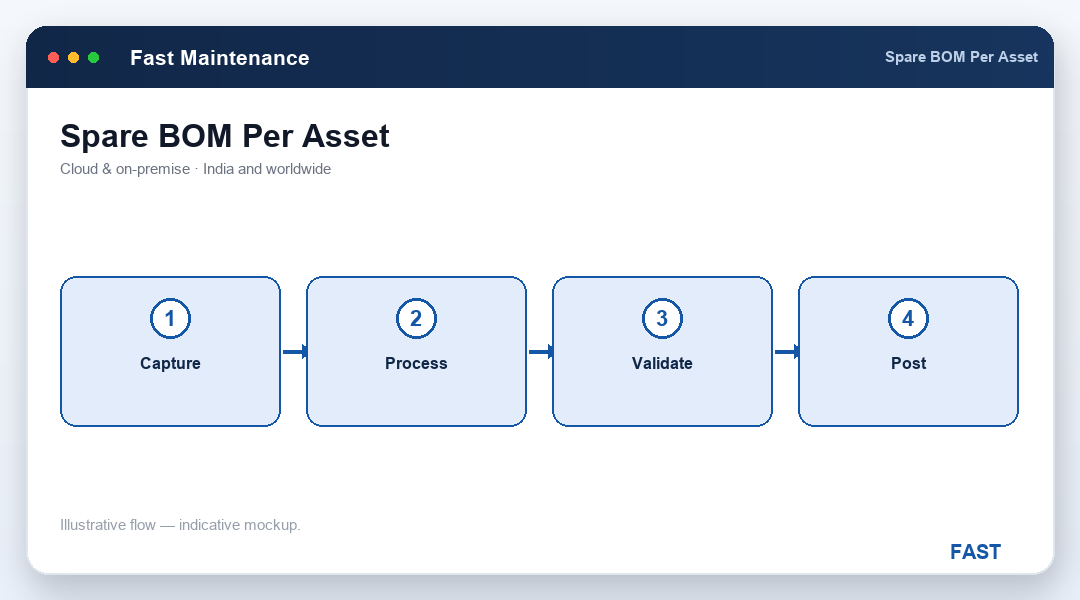
A spare BoM ties spares to the asset they fit, so opening a machine shows exactly which parts it consumes — no more guessing which bearing belongs to which spindle. When maintenance needs one, you issue the spare against the job: stock reduces immediately, and the cost attaches to that machine's maintenance history. So the spare register and the asset register agree, and every issue is a document you can trace back to the exact repair.
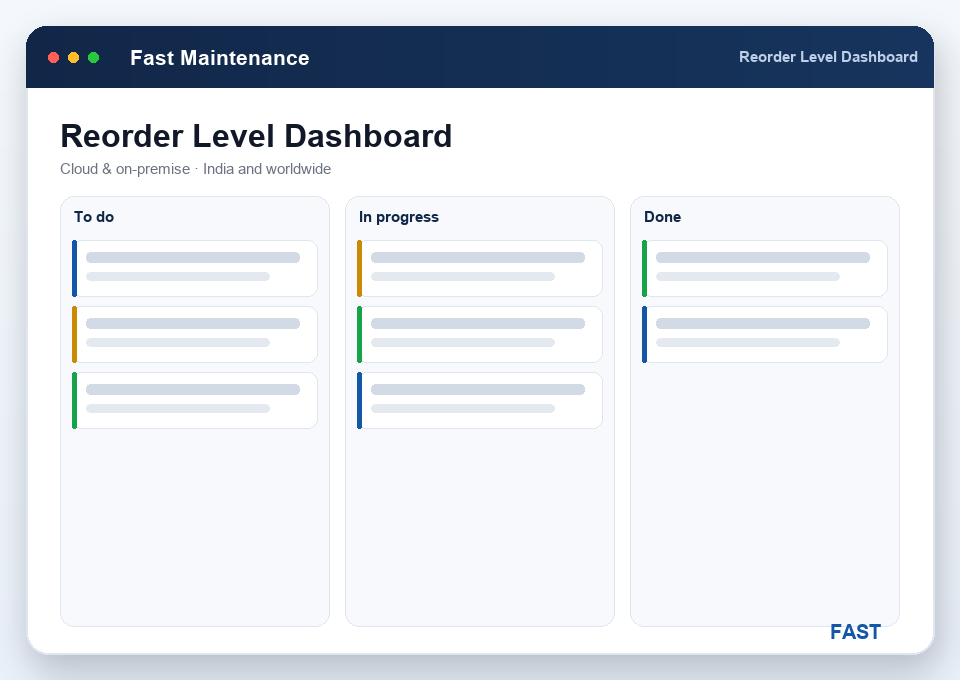
A critical spare at zero is a machine down and a plant waiting. Each spare carries a reorder level and a reorder quantity, and the reorder-level dashboard lists every item that has dropped to or below its point, so the store raises a purchase before the shelf is empty — not after a fitter finds it bare. Consumption-per-day and service-due-days help you set sensible levels, so fast-moving spares carry more cover than the ones you touch once a year.
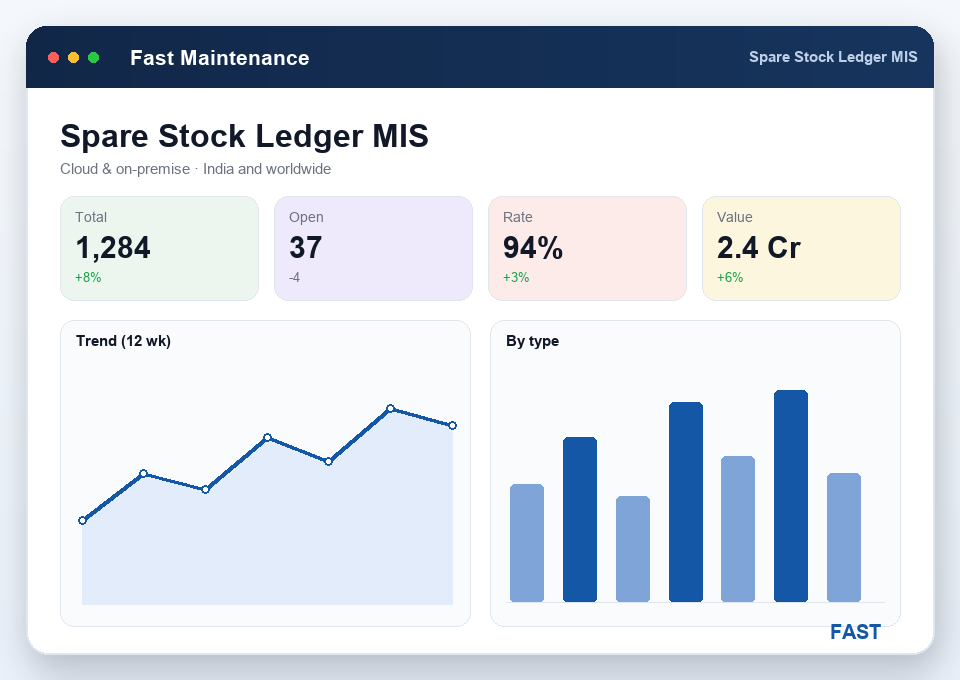
Every receipt and issue lands on the spare stock report and the spare ledger, so on-hand quantity is live and traceable — you can see exactly which spare went to which asset and when. The spare-part MIS rolls that up into consumption and value by spare, by asset or by period, which is the number a maintenance manager needs to control spare spend and spot the machines quietly draining the store. It shares the stock engine with maintenance inventory and purchase, so a reorder becomes procurement and comes back as stock on receipt.
Item code, description, UOM, quantity and rate for every spare — plus reorder level, reorder qty and consumption-per-day.
Link each spare to the assets it fits, so every machine shows its own spare list — no guessing which part belongs to which asset.
Issue a spare against a repair or asset — stock reduces immediately and the cost attaches to the machine's maintenance history.
Reorder levels and reorder quantities on every spare, with a dashboard that lists every item below its point before it runs out.
A spare stock report with live on-hand quantity and a spare ledger of every receipt and issue, traceable per spare and per asset.
Consumption and value summarised by spare, asset or period — the numbers a maintenance manager needs to control spare spend.
Most spare pain isn't buying — it's not knowing which spare fits which machine, or finding the critical one at zero. Here is what changes.
A spare BoM (bill of materials) is the list of spare parts a specific machine consumes — the belts, bearings, seals, filters and consumables tied to that asset in the asset register. Because each spare is linked to the machine it fits, an engineer opening an asset immediately sees the right spares, and issuing a spare for a repair is a lookup rather than a hunt through a store.
A spare is issued from the store against a maintenance job or asset, and the issue posts to the spare ledger so stock reduces immediately and the cost is attached to that machine's maintenance history. Every issue is a document, so you can always see which spare went to which asset and when — including spares issued against an asset repair.
Each spare in the spare-part master carries a reorder level and reorder quantity, along with consumption-per-day and service-due-days. When on-hand stock drops to the reorder level the item surfaces on the reorder-level dashboard, so the store raises a purchase before a critical spare runs out — not after a machine is already down waiting for it.
You get a spare stock report and a spare ledger showing every receipt and issue, a reorder-level dashboard of items below their reorder point, and a spare-part MIS summarising consumption and value by spare, asset or period — the numbers a maintenance manager needs to control spare spend.
Yes. Spare receipts, issues and reorder signals run on the same stock engine used for maintenance procurement, so a reorder raised against a low spare flows into purchase and back into stock on receipt. Fast Maintenance runs cloud or on-premise and suits manufacturers of every kind, across India and worldwide.
Live demo on your own spares — your spare BoM per machine, your reorder levels and your issue flow. No generic slideshow.