
Every maintenance team knows its two ways of working. There is the calm one — the scheduled check, done in a planned window, before anything goes wrong. And there is the loud one — the 2am call, the stopped line, the scramble for a spare that may or may not be on the shelf. The difference between a plant that runs and a plant that lurches is mostly the ratio between the two.
This is a practical guide to that ratio. It covers what breakdown maintenance and preventive maintenance actually are, the real cost trade-off between them, when each strategy is the right one, how to shift more of your work from reactive to planned, and the role of PM schedules, checklists and safety work permits in making the shift stick. If you want the wider context first — the whole asset lifecycle a CMMS manages — start with our pillar guide, what is CMMS software?
1. The hidden cost of breakdown maintenance
Breakdown maintenance is seductive because it looks cheap. You do nothing until a machine fails, so there is no spend — until there is. The problem is that the bill for a failure arrives all at once, and most of it is invisible on the maintenance ledger.
- Unplanned downtime is the big one. When a machine stops mid-run, you lose production you had already promised, operators stand idle, and dispatches slip. The repair time is the small part; the lost output around it is the large part.
- Emergency spares cost more. A spare you did not stock has to be sourced now, at whatever price and lead time the market offers. The same part that would have cost little on a planned order becomes expensive and slow when the line is already down.
- Failures cause other failures. A bearing that seizes can take a shaft with it; a leak left running can damage what is downstream. A failure caught early on a preventive check is a small job; the same failure caught late is several.
- Safety and quality risk rise. A machine that fails mid-process can produce scrap, or fail in a way that endangers the operator. Reactive work done in a hurry, without a work permit, is where incidents happen.
None of these land on the "maintenance cost" line, which is exactly why breakdown maintenance looks cheaper than it is. The first job of a CMMS is to make the true cost visible — by capturing every breakdown as a ticket with its downtime, so the hours lost stop being invisible.
2. Preventive vs breakdown — the definitions side by side
Before comparing cost, it helps to be precise about the two terms, because a plant that blurs them cannot manage the balance between them. A third category — emergency maintenance — is simply the most urgent form of breakdown work, and planned maintenance is a broader label for scheduled work that includes preventive.
- Repair after the asset has failed
- Captured as a breakdown ticket with downtime
- Unplanned — stops production without warning
- Emergency maintenance is its most urgent form
- Scheduled work before failure
- Time-based or usage-based schedules
- Carries a checklist and safety work permit
- Keeps the asset healthy and extends its life
Breakdown maintenance is the response to a failure that has already happened. In a CMMS it becomes a breakdown ticket: the downtime clock starts, the job is assigned, spares are issued against it, the repair is done, and the maintenance history is updated. It is reactive by definition — you are always one step behind the machine.
Preventive maintenance is work done to stop the failure occurring in the first place. Its schedules are either time-based (every month, every quarter) or usage-based (every so many running hours or cycles), and each job carries a checklist so the same inspection is done the same way every time. It is proactive — you are one step ahead of the machine. Both are legitimate; the question a maintenance manager answers is how much of each, for which assets.
3. The cost trade-off
Set the two strategies against each other and the trade-off becomes clear. Preventive maintenance costs something every cycle whether or not the asset would have failed; breakdown maintenance costs nothing until the asset fails, and then costs a great deal at once.
| Aspect | Breakdown (reactive) | Preventive (planned) |
|---|---|---|
| When you spend | Only when the asset fails | Every scheduled cycle, planned ahead |
| Downtime | Unplanned, stops production without warning | Planned, taken in a chosen window |
| Spares | Often emergency, expedited, premium-priced | Stocked ahead against reorder levels |
| Total cost profile | Low until failure, then multiplies | Predictable planned labour and spares |
| Effect on asset life | Wear runs unchecked; life shortens | Condition maintained; life extended |
| Effect on MTBF / MTTR | Failures frequent; repairs often slow | Failures rarer; repairs faster and planned |
The reason preventive maintenance usually wins on a critical asset is not that it is cheap — it is that it is predictable and smaller. A planned check costs a known amount of labour and a known spare; the failure it prevents costs an unknown amount of downtime plus an expedited spare plus the risk of collateral damage. Over the life of the asset, the sum of many small, planned costs is typically lower than the sum of a few large, unplanned ones. But — and this matters — that logic only holds where the failure is expensive. For a cheap, non-critical, quickly-replaced asset, the arithmetic can reverse.
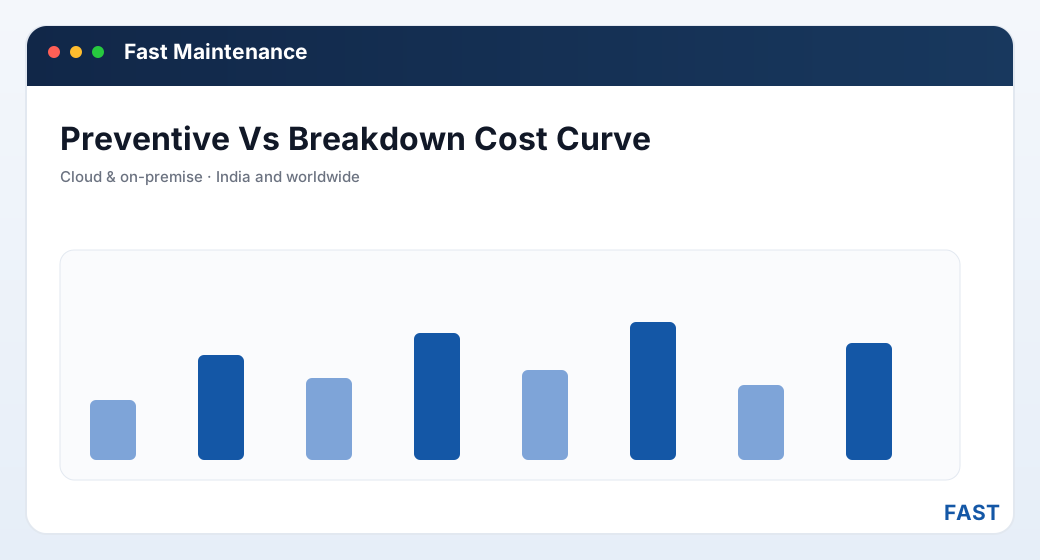
The classic trade-off: as preventive effort rises, failure cost falls but preventive cost climbs. Total cost is lowest at a mix, not at either extreme. The shape is illustrative — the point is that all-preventive and all-reactive are both usually wrong.
4. When each strategy applies
Because the trade-off depends on the asset, the right strategy is not one or the other for the whole plant — it is chosen per asset, based on how much a failure would cost. The deciding factor is criticality.
- The asset is critical — its failure stops production
- Failure risks safety, quality or collateral damage
- Spares are expensive or long-lead
- The asset wears predictably with time or use
- The asset is low-criticality and non-blocking
- It is cheap and quick to replace
- Redundancy means failure doesn't stop the line
- A preventive programme would cost more than it saves
The mistake to avoid is treating every asset the same. Blanket preventive maintenance wastes labour on assets that would be cheaper to run to failure; blanket run-to-failure gambles the critical assets. The discipline is to classify assets by criticality — using a mix of production impact, safety, spare cost and failure history — and then apply preventive maintenance where the failure hurts and run-to-failure where it does not. A CMMS holds the asset register and the breakdown history that make that classification evidence-based rather than a guess.
Deciding which assets deserve preventive maintenance is only credible when you can see how each one has actually behaved. A CMMS asset history report shows every past breakdown, its downtime and its cause, so the criticality call becomes evidence rather than opinion. See how the asset register and MTTR/MTBF dashboards supply that history.
5. How to shift the ratio toward preventive
Most plants that want to reduce breakdowns already know they should do more preventive work. The hard part is making the shift actually happen, on the assets where it pays, without drowning the team in low-value checks. Four moves do most of the work.
- Rank each asset by the cost of its failure — production impact, safety, spare cost, lead time
- Concentrate preventive effort on the critical few; let the trivial many run to failure
- Use the asset register to hold the classification so it drives scheduling
- Read the asset history report to see which assets fail most and why
- A machine with recurring breakdowns is a candidate for a targeted preventive schedule
- Let Dhruv AI cluster breakdown-cause remarks so the repeating causes surface
- Set time- or usage-based schedules for the critical assets on a maintenance calendar
- Raise PM-due alerts by email, SMS or WhatsApp so the service is not forgotten
- Attach a checklist and, where needed, a safety work permit to each job
- Watch MTBF rise and breakdown hours fall as preventive work takes hold
- If an asset still fails despite its schedule, tighten the interval or the checklist
- If an asset never fails, consider relaxing its schedule to save effort
The shift is a loop, not a one-off. Each round of preventive work generates history, the history refines the schedules and the criticality ranking, and the refined plan makes the next round more effective. A CMMS is what closes that loop — because the schedule, the alert, the breakdown record and the reliability trend all live in one place. For the metrics that tell you whether the shift is working, see MTTR & MTBF explained.
6. The role of PM schedules, checklists and work permits
Preventive maintenance lives or dies on three things being reliable: the schedule firing on time, the work being done consistently, and hazardous work being controlled. Each has a tool.
- Schedules and the maintenance calendar. A time- or usage-based schedule that raises a PM-due alert is what turns "we should service that quarterly" into a service that actually happens on time. Without the alert, preventive intentions slip into breakdowns.
- Checklists. A checklist makes a preventive job repeatable — the same inspection points, in the same order, whoever does the work. It captures the early signs of wear consistently, instead of depending on one experienced technician remembering what to look at.
- Safety work permits. For hazardous work — lockout, working at height, hot work — a safety work-permit checklist ensures the job is authorised and controlled before it starts. This is where preventive maintenance protects people, not just machines.
- History and photos. Recording what was found and done, with photographs, builds the record that feeds the next criticality decision and satisfies an audit.
Together these turn preventive maintenance from a good intention into a disciplined, auditable routine. A CMMS attaches the checklist and permit to the scheduled job, fires the alert, and keeps the completed record — so the discipline does not depend on any one person. See Preventive & Planned and WhatsApp, Email & SMS alerts.
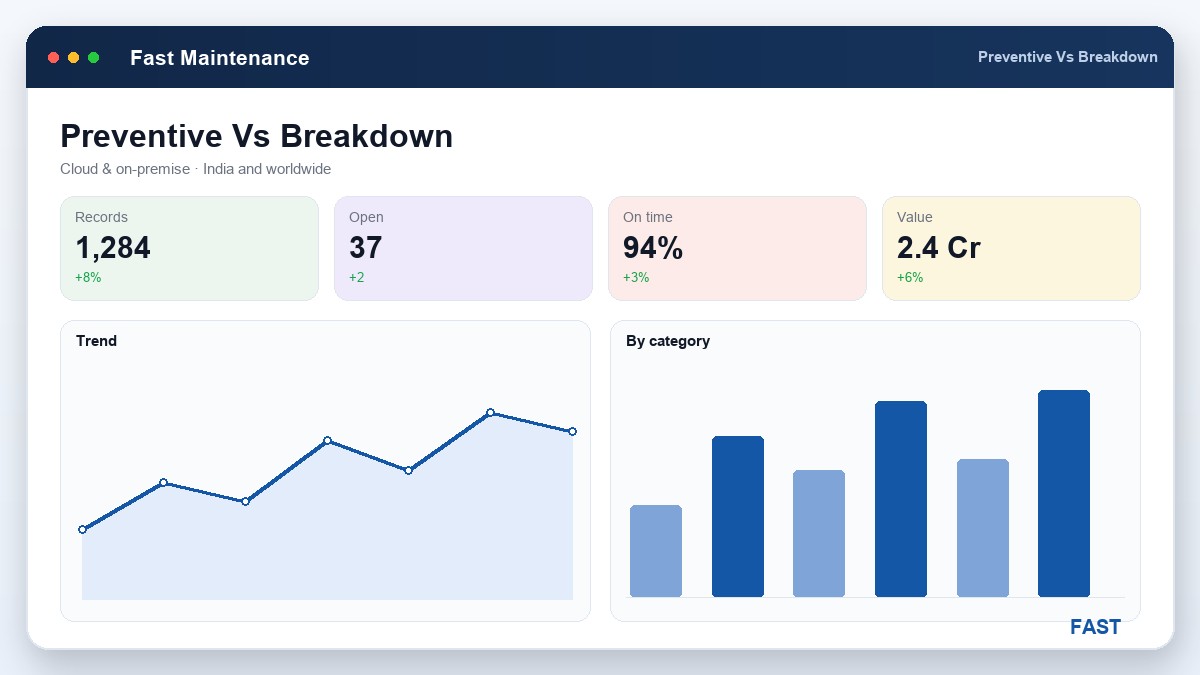
The mock dashboard below shows the idea a maintenance MIS produces — the split between preventive and breakdown work by asset class, with illustrative numbers, once every job is recorded:
| Asset class | Strategy | Preventive jobs | Breakdowns | Downtime hrs |
|---|---|---|---|---|
| CNC machines (critical) | Preventive-led | 24 | 3 | 9 |
| Hydraulic presses | Preventive-led | 18 | 4 | 14 |
| Compressors & DG sets | Preventive-led | 12 | 2 | 6 |
| Conveyors (non-critical) | Mixed | 6 | 7 | 11 |
| Spare motors (redundant) | Run-to-failure | 0 | 3 | 4 |
Illustrative figures inside a mock maintenance-MIS card — not real plant data. The pattern is what matters: critical assets carry mostly planned work and little downtime; redundant assets are left to run to failure by design.
7. Common traps that keep breakdowns high
Most plants that struggle to reduce breakdowns are not lazy — they are undermined by a handful of habits that keep them reactive. Naming them makes them easy to avoid:
- Treating every asset the same. Blanket preventive wastes effort; blanket run-to-failure gambles the critical assets. Without criticality classification, effort goes to the wrong machines.
- Schedules with no alert. A preventive plan on a wall planner that nobody is reminded about quietly becomes a breakdown plan. The alert is what makes the schedule real.
- No breakdown history. If failures are not captured with their downtime and cause, you cannot see which assets deserve preventive attention — so the shift never gets targeted.
- No spares for the planned work. A preventive schedule without the spare on the shelf turns a planned job into a wait. Reorder levels on critical spares keep preventive work flowing.
- Preventive without checklists. A service that depends on memory is done differently every time, so early wear is missed. A checklist makes the inspection repeatable.
- Never reviewing the ratio. If nobody watches the split between planned and reactive work over time, the plant cannot tell whether it is improving or sliding back.
8. How Fast Maintenance supports the shift
Fast Maintenance Software builds the whole balance into one workflow, so shifting toward preventive work is a matter of using the system rather than fighting it:
- Preventive, planned and emergency maintenance on one calendar. Time- and usage-based schedules drive a maintenance calendar, each job carrying its checklist and safety work permit. See Preventive & Planned.
- Breakdown tickets with downtime capture. Every breakdown and emergency is a ticket that records the downtime, is assigned, consumes spares, and updates the history — so the true cost of reactive work is finally visible. See Breakdown & Emergency.
- Spares ready for planned work. A spare parts list per asset with reorder levels keeps the store stocked, so a preventive job is not held up by a missing part. See Spare Parts & BoM.
- Alerts that make schedules real. PM-due, breakdown and reorder notifications go out over email, SMS and WhatsApp, so preventive work is not forgotten.
- Reliability dashboards to track the trend. Live machine status, MTTR and MTBF over time, and downtime analysis show whether the ratio is moving the right way. See Dashboards & MTTR/MTBF.
- Dhruv AI on the causes. Dhruv AI clusters breakdown-cause remarks into labelled themes and answers plain-English questions over your maintenance data, so the repeating causes worth a preventive schedule stand out.
The result is that the balance between preventive and breakdown work stops being a matter of habit and becomes a decision you can see, target and adjust — asset by asset, cloud or on-premise, for manufacturers of every kind across India and worldwide. For how it all fits together, start with what CMMS software is, and read how spare-part management keeps both planned and reactive work moving.
9. Frequently asked questions
See your preventive-to-breakdown ratio on screen
A 30-minute demo — the maintenance calendar, PM checklists, breakdown tickets and MTTR/MTBF trend, on your own assets.